
Binomial Theorem: Complete Class Notes, Formulas, and Properties
Learning Resources
Binomial Theorem – As the power increases, the expansion becomes lengthy and tedious to calculate. A binomial expression that has been raised to a very large power can be easily calculated with the help of the Binomial Theorem. On this page, you will learn the definition and statement of binomial theorem, binomial expansion formulas, properties of binomial theorem, how to find the binomial coefficients, terms in the binomial expansion, applications, etc.
Binomial Theorem Statement
The binomial theorem is the method of expanding an expression that has been raised to any finite power. A binomial theorem is a powerful tool of expansion which has applications in Algebra, probability, etc.
Binomial Expression: A binomial expression is an algebraic expression that contains two dissimilar terms. Eg.., a + b, a3 + b3, etc.
Binomial Expansion
Important points to remember
- The total number of terms in the expansion of (x+y)n is (n+1)
- The sum of exponents of x and y is always n.
- nC0, nC1, nC2, … .., nCn are called binomial coefficients and also represented by C0, C1, C2, ….., Cn
- The binomial coefficients, which are equidistant from the beginning and from the ending, are equal, i.e., nC0 = nCn, nC1 = nCn-1 , nC2 = nCn-2 ,….. etc.
Binomial Expansion Formula: Let n ∈ N,x,y,∈ R then
(x + y)n = nΣr=0 nCr xn – r · yr where,
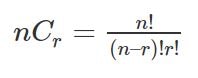
Illustration 1: Expand (x/3 + 2/y)4
Sol:

Illustration 2: (√2 + 1)5 + (√2 − 1)5
Sol:
We have
(x + y)5 + (x – y)5 = 2[5C0 x5 + 5C2 x3 y2 + 5C4 xy4]
= 2(x5 + 10 x3 y2 + 5xy4)
Now (√2 + 1)5 + (√2 − 1)5 = 2[(√2)5 + 10(√2)3(1)2 + 5(√2)(1)4]
=58√2
View PDF
Share This Note