JEE Main vs JEE Advanced 2026 — Key Differences, Syllabus & How to Prepare for Both
Introduction
Every student who dreams of engineering at an IIT or NIT starts with one question that almost nobody answers clearly — what exactly is the difference between JEE Main and JEE Advanced, and do I need to prepare for them differently?
The short answer is yes — they are two very different examinations. One is the gateway, the other is the destination. One tests your knowledge, the other tests your thinking. One can be cracked with hard work and smart strategy, the other demands that plus something deeper — genuine conceptual mastery and the ability to think under extreme pressure.
This guide breaks down every single difference between JEE Main and JEE Advanced — the pattern, the syllabus, the difficulty, the eligibility, the scoring, and most importantly, the preparation strategy for each. Whether you are a Class 11 student just beginning your JEE journey or a Class 12 student in the thick of preparation, this is the most complete guide you will find.
What is JEE Main?
JEE Main — Joint Entrance Examination Main — is a national-level entrance exam conducted by the National Testing Agency (NTA). It is the first and mandatory step in the two-stage JEE process.
JEE Main serves two purposes. First, it is the direct admission exam for NITs, IIITs, and GFTIs — the National Institutes of Technology, Indian Institutes of Information Technology, and Government Funded Technical Institutes across India. There are over 23,000 seats in NITs alone, and JEE Main is the only path to them.
Second, JEE Main is the qualifying exam for JEE Advanced. Only the top 2.5 lakh rank holders in JEE Main are eligible to appear in JEE Advanced. Without clearing JEE Main with a sufficiently high percentile, the IIT dream simply cannot move forward.
JEE Main is conducted twice a year — in January and April — giving students two attempts and the flexibility to use their best score.
What is JEE Advanced?
JEE Advanced is the second stage of the IIT admission process and is one of the most challenging undergraduate entrance examinations in the world. It is conducted by one of the seven old IITs on a rotational basis — IIT Bombay, IIT Delhi, IIT Madras, IIT Kanpur, IIT Kharagpur, IIT Roorkee, and IIT Guwahati.
A good JEE Advanced score combined with subject-wise cutoffs (called AAT for Architecture and rank-based cutoffs for engineering) determines admission to all 23 IITs, including IIT Bombay, IIT Delhi, IIT Madras, and IIT Kanpur — the most prestigious engineering colleges in Asia.
JEE Advanced is conducted once a year, has no defined syllabus document as comprehensive as JEE Main, and includes question types that require genuinely original thinking — not just formula application. It is a different beast entirely, and it deserves a different preparation approach entirely.
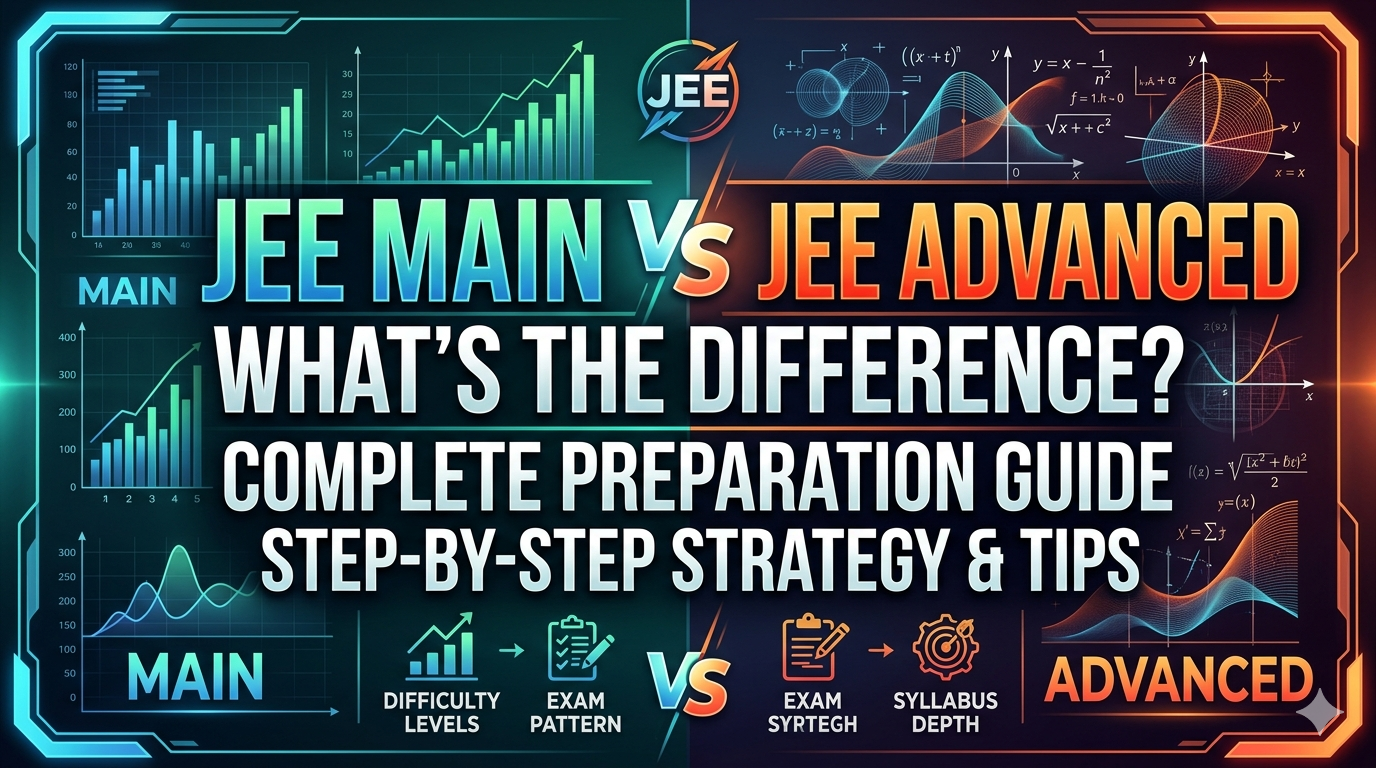
EE Main vs JEE Advanced — Complete Comparison Table
| Parameter | JEE Main | JEE Advanced |
|---|---|---|
| Conducted by | NTA (National Testing Agency) | IITs (rotational) |
| Purpose | NITs, IIITs, GFTIs + qualifier for Advanced | IIT admissions |
| Frequency | Twice a year (Jan & April) | Once a year (May/June) |
| Mode | Computer Based Test (CBT) | Computer Based Test (CBT) |
| Papers | 1 paper | 2 papers (Paper 1 + Paper 2, both compulsory) |
| Duration | 3 hours | 3 hours per paper (6 hours total) |
| Total Marks | 300 | 360 (combined Paper 1 + 2) |
| Subjects | Physics, Chemistry, Maths | Physics, Chemistry, Maths |
| Eligibility | Class 12 pass or appearing | Top 2.5 lakh JEE Main qualifiers |
| Attempts | 3 attempts in 3 consecutive years | 2 attempts in 2 consecutive years |
| Difficulty | Moderate to High | Very High to Extreme |
| Question types | MCQ + Numerical Answer Type | MCQ Single, MCQ Multi-correct, Numerical, Match the column, Paragraph-based |
| Negative marking | Yes (–1 for MCQ wrong) | Complex — varies by question type |
| Syllabus document | Official NTA syllabus published | Broad official syllabus — but goes deeper |
| Result type | Percentile score + rank | Rank only (subject-wise + overall) |
| Seats available | 23,000+ (NITs) + IIITs + GFTIs | ~17,000 (all 23 IITs) |
Difference in Exam Pattern — Detailed Breakdown
JEE Main Pattern (2026)
JEE Main has one paper for B.E./B.Tech aspirants divided into three sections — Physics, Chemistry, and Mathematics. Each subject has:
Section A — 20 MCQ questions with single correct answer. Each correct answer gives +4 marks and each wrong answer carries –1 negative marking.
Section B — 10 numerical answer type questions out of which you attempt any 5. These carry +4 marks each with no negative marking. This section is crucial because the absence of negative marking allows calculated risk-taking.
Total: 90 questions, 75 to attempt, 300 marks, 3 hours.
The paper is conducted entirely on computer. Questions are generally application-based — meaning you need to know the concept, apply the formula, and calculate. Speed and accuracy together determine your JEE Main score.
JEE Advanced Pattern (2026)
JEE Advanced has two compulsory papers — Paper 1 and Paper 2 — each of 3 hours. Both papers cover Physics, Chemistry, and Mathematics.
What makes JEE Advanced genuinely different is its question variety. In any given paper you may encounter single correct MCQs, multiple correct MCQs (where 2, 3, or all 4 options may be correct — partial marking applies), integer answer type questions (you type a number, no options given), match the list questions, and paragraph-based questions where a long passage is followed by multiple questions.
The marking scheme in JEE Advanced is not uniform — it varies by question type and paper. Multi-correct questions give partial marks if you get some options right but not all, and negative marks if you select a wrong option. This complexity demands a completely different exam strategy than JEE Main.
Total marks vary by paper and year but is generally around 180 per paper — 360 combined.
Difference in Syllabus — What Changes?
On paper, both JEE Main and JEE Advanced cover the same subjects — Physics, Chemistry, and Mathematics from Class 11 and 12. But the depth, the approach, and the application level are dramatically different.
Physics
In JEE Main, Physics questions test direct concept application. You know the formula, you plug in the numbers, you get the answer. The concepts themselves are Class 11 and 12 level — no surprises.
In JEE Advanced, Physics questions often combine multiple concepts in a single problem. A mechanics problem might involve energy conservation, rotational dynamics, and friction simultaneously. Questions test whether you truly understand physics or simply memorized formulas. Topics like Modern Physics, Optics, and Electrostatics appear with multi-concept integration that requires genuine physics intuition.
Chemistry
JEE Main Chemistry is heavily NCERT-based, especially for Inorganic Chemistry. Physical Chemistry requires numerical problem-solving. Organic Chemistry tests reaction mechanisms and named reactions.
JEE Advanced Chemistry goes deeper. Organic Chemistry problems can involve multi-step synthesis, and questions often test whether you can predict products in unusual conditions. Inorganic Chemistry has a reputation for unexpected and highly specific questions. Physical Chemistry numericals in Advanced are more calculation-intensive.
Mathematics
This is where the gap between JEE Main and JEE Advanced is most stark. JEE Main Mathematics tests standard problem types — integration, matrices, probability, coordinate geometry. Practice enough similar problems and you can score well.
JEE Advanced Mathematics is a different challenge entirely. Problems are often original, multi-step, and require combining ideas from multiple chapters. Calculus problems at the Advanced level can require genuine mathematical thinking, not just formula recall. Algebra and Coordinate Geometry problems at the Advanced level often have elegant solutions that are not obvious and reward deep understanding.
Additional Topics in JEE Advanced
JEE Advanced includes some topics not explicitly in JEE Main — particularly in Chemistry and Mathematics. These include topics like electrochemistry at greater depth, certain advanced organic chemistry concepts, and mathematical topics like properties of triangles and inverse trigonometry at a deeper level. Always refer to the official JEE Advanced information brochure for the complete topic list each year.
How to Prepare for JEE Main — Strategy & Tips
Build a Strong NCERT Foundation First
JEE Main Chemistry, especially Inorganic Chemistry, is heavily NCERT-based. Every student must read NCERT Chemistry thoroughly. Physics and Mathematics from NCERT build the conceptual foundation on which reference book problems rest.
Master the Standard Problem Types
JEE Main has identifiable problem patterns. Physics Mechanics, Electrostatics, and Optics questions follow recognizable structures. Mathematics Coordinate Geometry, Integration, and Probability have standard approaches. Practice enough previous year papers and the pattern becomes very clear.
Speed and Accuracy Training
JEE Main is a 3-hour exam for 75 questions — that is 2.4 minutes per question. Speed matters enormously. Practice solving problems within time limits from the beginning of your preparation, not just before the exam. Regular timed mock tests are non-negotiable.
Solve Previous Year Papers Religiously
The last 10 years of JEE Main papers are a gold mine. Many question types repeat with slight variations. Solving all previous year papers chapter-wise first, then as full mocks, is the single most efficient preparation strategy for JEE Main.
Use Both January and April Attempts Strategically
Since JEE Main is conducted twice, use the January attempt as a real exam experience — regardless of your preparation level. The experience of sitting in an actual JEE Main exam hall is invaluable. Your April attempt then benefits from that psychological familiarity.
The PRAYAS JEE Advantage
Scholar's Mate Bhagalpur's PRAYAS JEE test series is specifically designed to prepare students for JEE Main conditions — timed full mocks, JEE Main pattern questions, All India percentile ranking, and detailed topic-wise performance analysis. Students who complete the full PRAYAS program consistently perform better in the actual JEE Main because they have already experienced the exam conditions dozens of times.
How to Prepare for JEE Advanced — Strategy & Tips
Conceptual Depth Over Formula Memorization
JEE Advanced cannot be cracked by formula memorization. Every concept must be understood from first principles. When you study a Physics topic, ask why — why does this formula work, what are its limits, what happens if one condition changes. This depth of understanding is what Advanced questions test.
Multi-Concept Problem Solving
Start solving problems that combine multiple chapters from early on in your preparation. A JEE Advanced problem might require Mechanics + Thermodynamics together, or Algebra + Calculus in Mathematics. Practice such integrated problems regularly.
Study the Last 15 Years of JEE Advanced Papers
JEE Advanced paper setters have aesthetic preferences — they favor certain types of elegant problems. Studying 15 years of Advanced papers gives you a feel for what genuine Advanced-level thinking looks like. This is arguably the most important preparation activity for Advanced.
Master Multi-Correct MCQs
Multi-correct MCQs are unique to JEE Advanced and most students struggle with them. The strategy — never guess on multi-correct. Only mark an option if you are genuinely confident it is correct. Partial marks for partial correctness are real but wrong option selection carries negative marks that can destroy your score.
Separate Preparation Time for Advanced Topics
Once your JEE Main preparation reaches a strong level, dedicate specific study sessions exclusively to Advanced-level problem solving. Use books like Irodov for Physics, JD Lee for Inorganic Chemistry, and advanced problem books for Mathematics. The jump from JEE Main level to JEE Advanced level is significant and requires dedicated effort.
Build Mental Stamina for 6 Hours of Examination
JEE Advanced is two papers of 3 hours each, often on the same day. Physical and mental fatigue is a real factor. Take full 6-hour mock tests that simulate both papers back-to-back. Build the stamina to stay sharp through a 6-hour examination day.
Ideal Preparation Timeline
Class 11 — Foundation Year
Focus entirely on understanding concepts deeply from the start. Do not rush through topics. Build the habit of solving problems beyond NCERT in all three subjects. Begin JEE Main-level mock tests by the end of Class 11 to understand where you stand.
This is also the time to build the deep conceptual foundation that JEE Advanced rewards. Every Physics concept understood from first principles in Class 11 is an investment that pays back enormously in Class 12 Advanced preparation.
Class 12 — Execution Year
Complete the Class 12 syllabus by November at the absolute latest. From December onwards, shift entirely to revision, mock tests, and advanced problem solving. Take JEE Main mock tests weekly from October. Attempt JEE Main in January. Use the gap between January and April JEE Main to strengthen weak areas and begin Advanced-level problem practice seriously.
After April JEE Main, shift full focus to JEE Advanced — multi-concept problem solving, previous year Advanced papers, and full 6-hour mock simulations.
Dropper Year — Strategic Repetition
A dropper year is not about learning everything again — it is about identifying exactly what went wrong in the previous attempt and fixing it systematically. Take a diagnostic full mock in Week 1. Identify weak chapters. Build a targeted revision and practice plan. Take JEE Main and Advanced mock tests from Month 3 onwards.
Common Mistakes Students Make
Preparing only for JEE Main and expecting to do well in JEE Advanced without separate effort — this is the most common and most costly mistake. The preparation overlap is about 70%. The remaining 30% — depth, multi-concept problems, Advanced paper strategy — requires dedicated separate effort.
Ignoring mock tests until the last two months — both exams reward exam temperament and time management that only comes from regular testing throughout the year, not crash-course mock sessions in the final weeks.
Spending equal time on all chapters regardless of weightage — both JEE Main and Advanced have high-weightage chapters. Knowing which chapters to prioritize and allocating preparation time accordingly is a strategic advantage.
Not analysing wrong answers after mock tests — solving a mock without reviewing every wrong answer in detail is almost useless. The review process is where the real learning happens.